
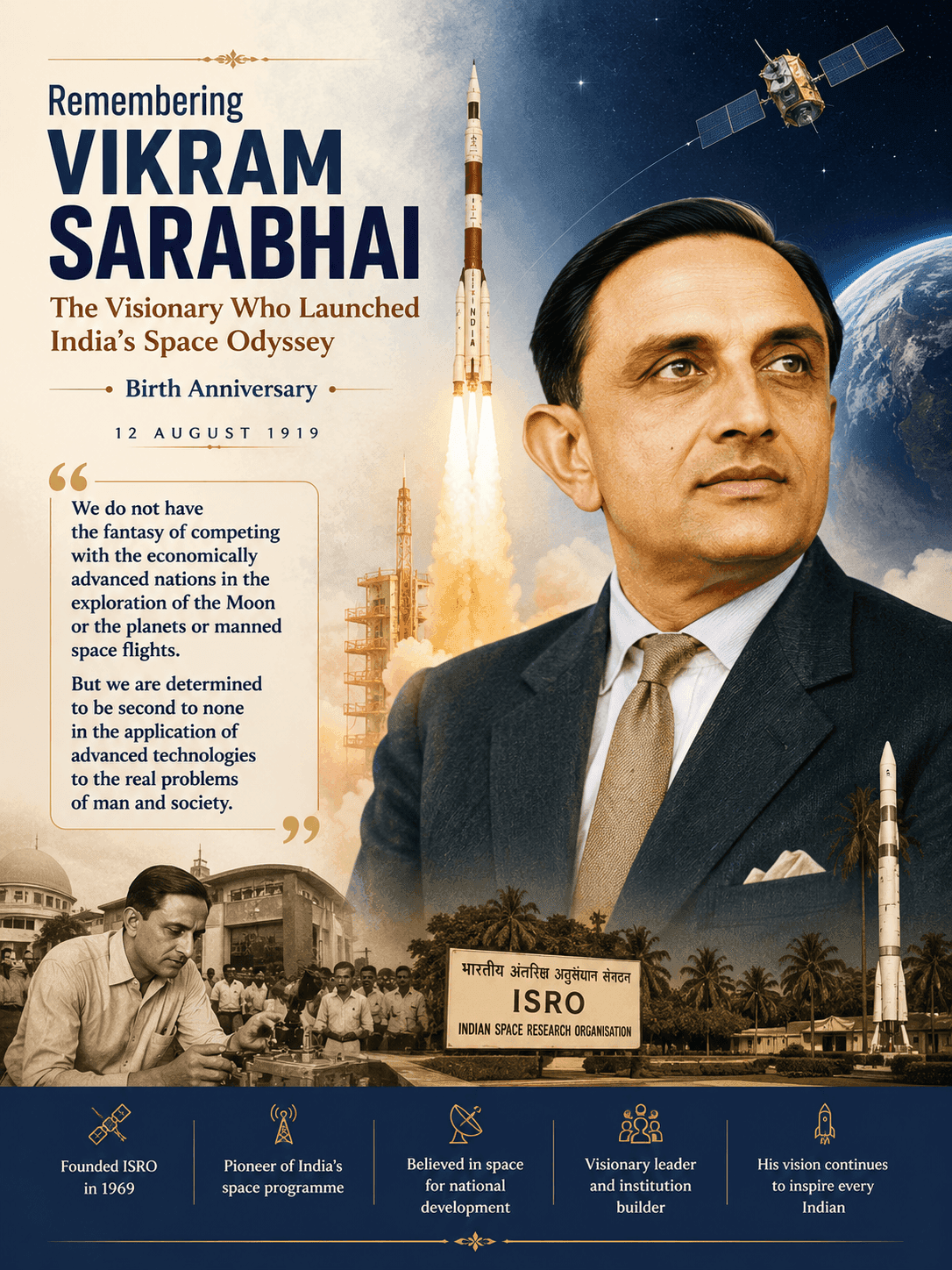
Vikram Sarabhai: The Visionary Who Launched India’s Space Odyssey
In the bustling city of Ahmedabad, Gujarat, a child was born on August 12, 1919, who would one day change the course of India’s scientific trajectory. Vikram Ambalal Sarabhai, hailing from a family of industrialists and freedom fighters, was destined for greatness. His father, Ambalal Sarabhai, was a prominent industrialist and a key figure in India’s independence movement. This environment fostered in Vikram a deep sense of purpose and a passion for science.
Vikram’s academic journey took him to St John’s College, Cambridge, in 1938, where he pursued experimental physics. However, the onset of World War II interrupted his studies, leading him to return to India. Undeterred, he completed his bachelor’s degree from Gujarat University and later earned his Ph.D. in experimental physics from Cambridge University in 1947. His doctoral research focused on cosmic rays, laying the foundation for his future endeavors.
In 1947, Vikram established the Physical Research Laboratory (PRL) in Ahmedabad, a modest facility dedicated to cosmic ray research. Under his visionary leadership, PRL evolved into a premier center for space science and technology in India. His belief that space technology could play a meaningful role in national development and solving societal problems led him to shape the Indian Space Programme in 1960. He envisioned using satellite television to bring education to the remotest villages, a testament to his forward-thinking approach.
Vikram’s contributions were not limited to space science. He was instrumental in establishing the Indian Institute of Management (IIM) Ahmedabad, aiming to provide world-class management education in India. His diverse interests also led him to set up the Ahmedabad Textile Industry’s Research Association (ATIRA), reflecting his commitment to industrial development.
In 1966, Vikram was appointed Chairman of the Atomic Energy Commission of India, succeeding Homi J. Bhabha. His tenure was marked by significant advancements in nuclear research and energy. His dedication to science and its applications earned him the Padma Bhushan in 1966 and the Padma Vibhushan posthumously in 1972.
Vikram’s personal life was equally remarkable. In 1942, he married Mrinalini Sarabhai, a renowned classical dancer and choreographer. Together, they had two children: Mallika Sarabhai, a distinguished dancer and activist, and Kartikeya Sarabhai, an educationist and environmentalist. The couple’s shared passion for the arts and sciences created a nurturing environment for their children’s growth.
Tragically, Vikram Sarabhai’s life was cut short on December 30, 1971, when he passed away at the age of 52 in Trivandrum. His untimely death was a significant loss to the scientific community and the nation. However, his legacy endures through the institutions he founded and the vision he instilled in India’s scientific community.
Vikram Sarabhai’s story is a beacon of hope, illustrating how one individual’s vision and determination can propel a nation into the future. His unwavering belief in the power of science to drive societal progress continues to inspire generations, reminding us of the profound impact of visionary leadership on a nation’s destiny.