
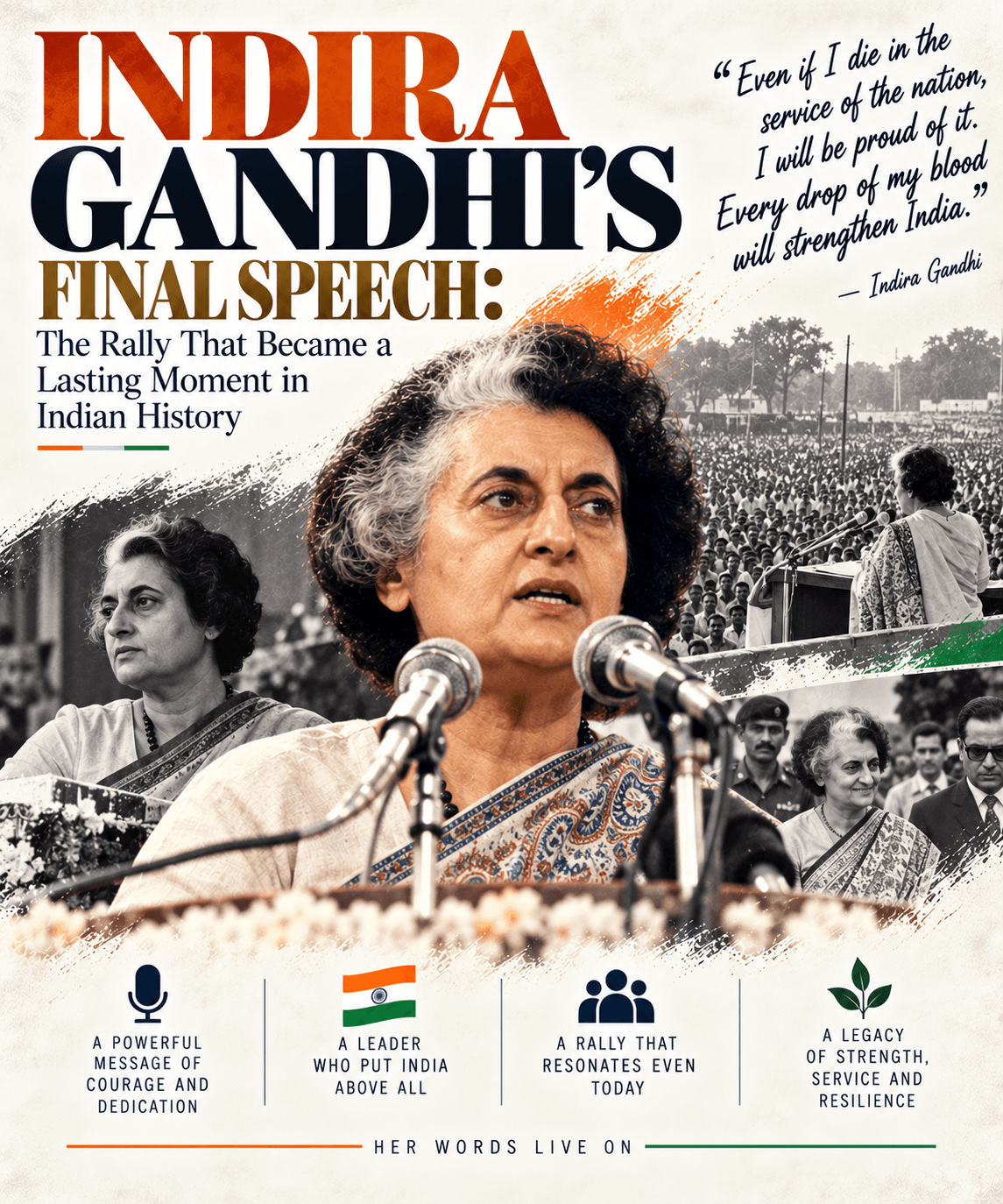
Indira Gandhi’s Final Speech: The Rally That Became a Lasting Moment in Indian History
The setting was a public rally in Bhubaneswar, but the moment carried significance far beyond the gathering itself. On October 30, 1984, Indira Gandhi delivered what became her final public speech. She was still India’s Prime Minister, addressing citizens at a time when the nation was passing through one of the most difficult periods in its post-independence political history.
Born on November 19, 1917, in Allahabad, Indira Priyadarshini Gandhi grew up in the centre of India’s freedom movement. Her father, Jawaharlal Nehru, was a leading figure in the struggle against British rule and became independent India’s first Prime Minister. Her mother, Kamala Nehru, was also associated with the national movement. From childhood, Indira observed political work, public responsibility and the challenges of building a new nation.
Her early experiences shaped a leader who understood politics not simply as administration, but as a force closely connected with ordinary people. After India became independent in 1947, she worked for a period as her father’s hostess and political aide. She later entered the leadership of the Indian National Congress and became party president in 1959. These years gave her experience of organisation, public communication and national politics.
Indira Gandhi became Prime Minister in 1966. Her tenure was marked by major developments, including the nationalisation of leading banks, the Green Revolution’s contribution to food security and India’s role in the creation of Bangladesh after the 1971 war. She also led the country during moments of intense political contestation. The Emergency, imposed between 1975 and 1977, remains one of the most debated chapters of her career because it involved the suspension of civil liberties and democratic freedoms.
After losing power in 1977, she returned as Prime Minister in 1980. By 1984, however, the political climate had become deeply strained. The Punjab crisis, Operation Blue Star and the continuing conflict surrounding separatist militancy placed enormous pressure on the central government and the country’s social fabric. These events created fear, anger and grief across communities, making the Prime Minister’s public appearances especially significant.
Against this backdrop, Indira Gandhi addressed a rally in Bhubaneswar on October 30. Her speech became historic because it was her last public address. The next day, October 31, she was assassinated in New Delhi by two of her security personnel. Her death shocked India and led to widespread national mourning, followed by severe communal violence in several parts of the country.
The Bhubaneswar speech is remembered not only because it came immediately before her death, but also because it captures the final public chapter of a political life shaped by independence, nation-building, crisis and controversy. Indira Gandhi’s legacy cannot be reduced to either admiration or criticism. It includes significant national decisions, powerful political achievements and actions that continue to invite serious debate.
For families passing Indian history from one generation to another, this moment offers a way to discuss leadership in its full complexity. Indira Gandhi’s final speech remains a reminder that public memory is built not only around victories, but also around the difficult choices and unsettled questions that define a nation’s journey.