
NCERT: The Institution That Helped Shape India’s Classrooms
In the first decades after independence, India faced the enormous task of building an education system that could serve a vast, diverse and newly developing nation. Schools needed better learning materials, teachers required professional support, and policymakers needed research to understand how education could reach more children. It was in this challenging setting that the National Council of Educational Research and Training, or NCERT, emerged.
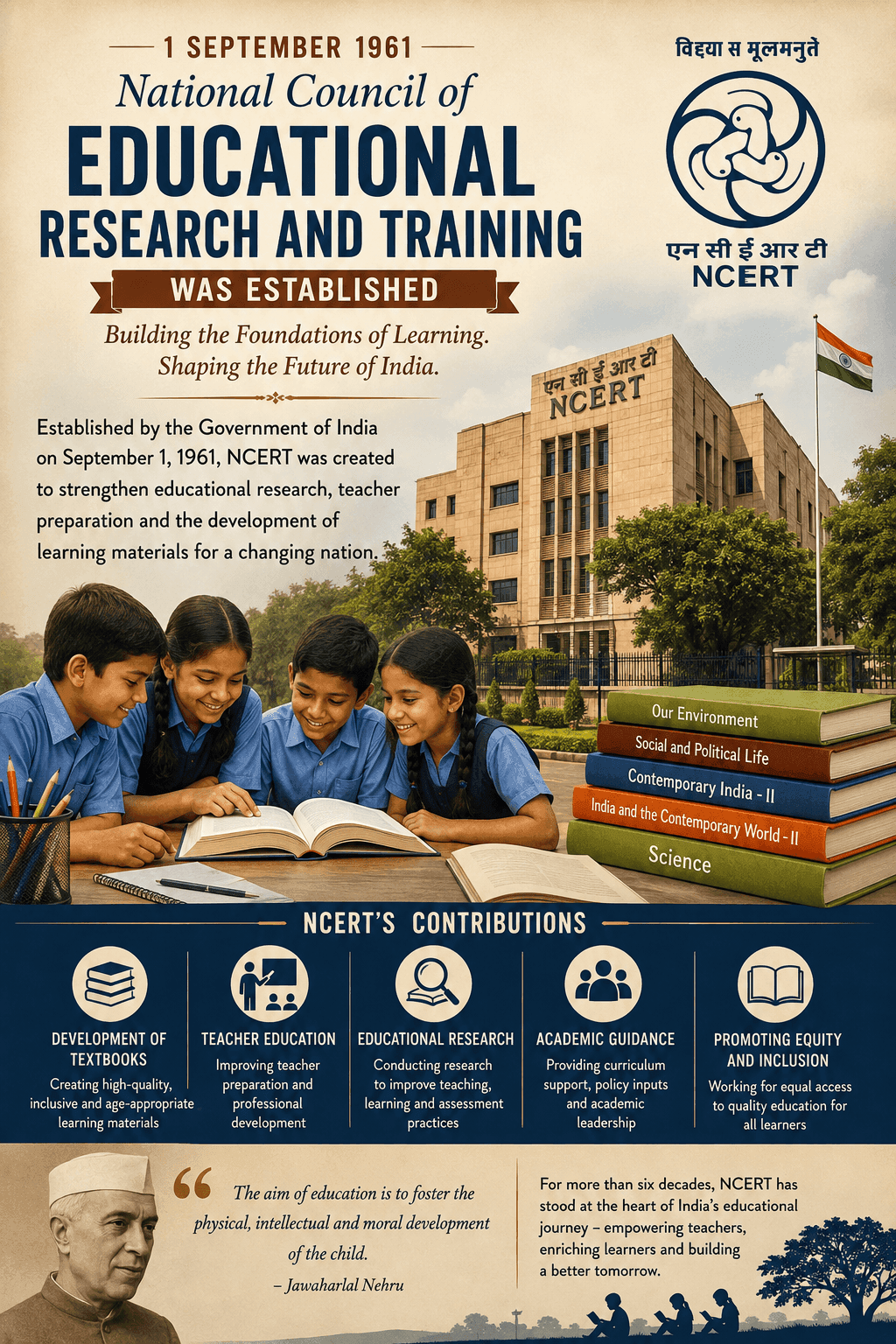
The Government of India established NCERT on September 1, 1961. Its creation reflected a national effort to bring greater coordination and depth to school education. Rather than treating education as a collection of separate activities, the new institution was designed to connect research, training, curriculum development and educational guidance.
NCERT began its work as an autonomous organisation under the Union government’s education ministry. Its central purpose was to assist the government and the states with improving the quality of school education. This meant studying educational questions, supporting teacher preparation, developing learning resources and helping translate educational thinking into classroom practice.
One of NCERT’s most visible contributions has been its role in preparing school textbooks and other academic materials. For millions of Indian families, the name NCERT became familiar through books used at school and later consulted during examinations and higher studies. These materials helped provide a common academic reference across regions, even as India continued to accommodate different languages, cultures and state education systems.
Textbooks, however, represent only one part of the institution’s work. NCERT has also been associated with educational research, curriculum development, teacher education, guidance and the use of new approaches in teaching and learning. Its programmes have supported discussions about how children learn, how teachers can be trained and how schools can respond to the needs of a changing society.
The organisation’s reach has extended beyond its headquarters in New Delhi. Its regional institutes have helped connect national educational efforts with the varied realities of different parts of India. This regional presence has been significant in a country where geography, language and social conditions can shape the experience of schooling in very different ways.
It is important to note that NCERT does not function as a school or a university for ordinary classroom enrolment. Its role is broader and more institutional: it helps build the knowledge, resources and professional support on which school systems depend. Through this work, it has influenced teachers, students, education officers and families, often without appearing directly in public view.
Throughout history, institutions are remembered not only for the date on which they were founded but also for the habits and opportunities they create. NCERT’s establishment on September 1, 1961, marked an important moment in India’s educational journey because it placed organised research and national academic support at the centre of school development.
In today’s world, debates about curriculum, textbooks, examinations and teaching methods remain closely connected to the questions NCERT was created to address. Its legacy can be seen whenever a family opens a schoolbook, a teacher adapts a lesson or an educationist searches for a better way to support children. This remarkable story deserves a place in India’s heritage because NCERT helped turn the idea of educational progress into a continuing national project.