
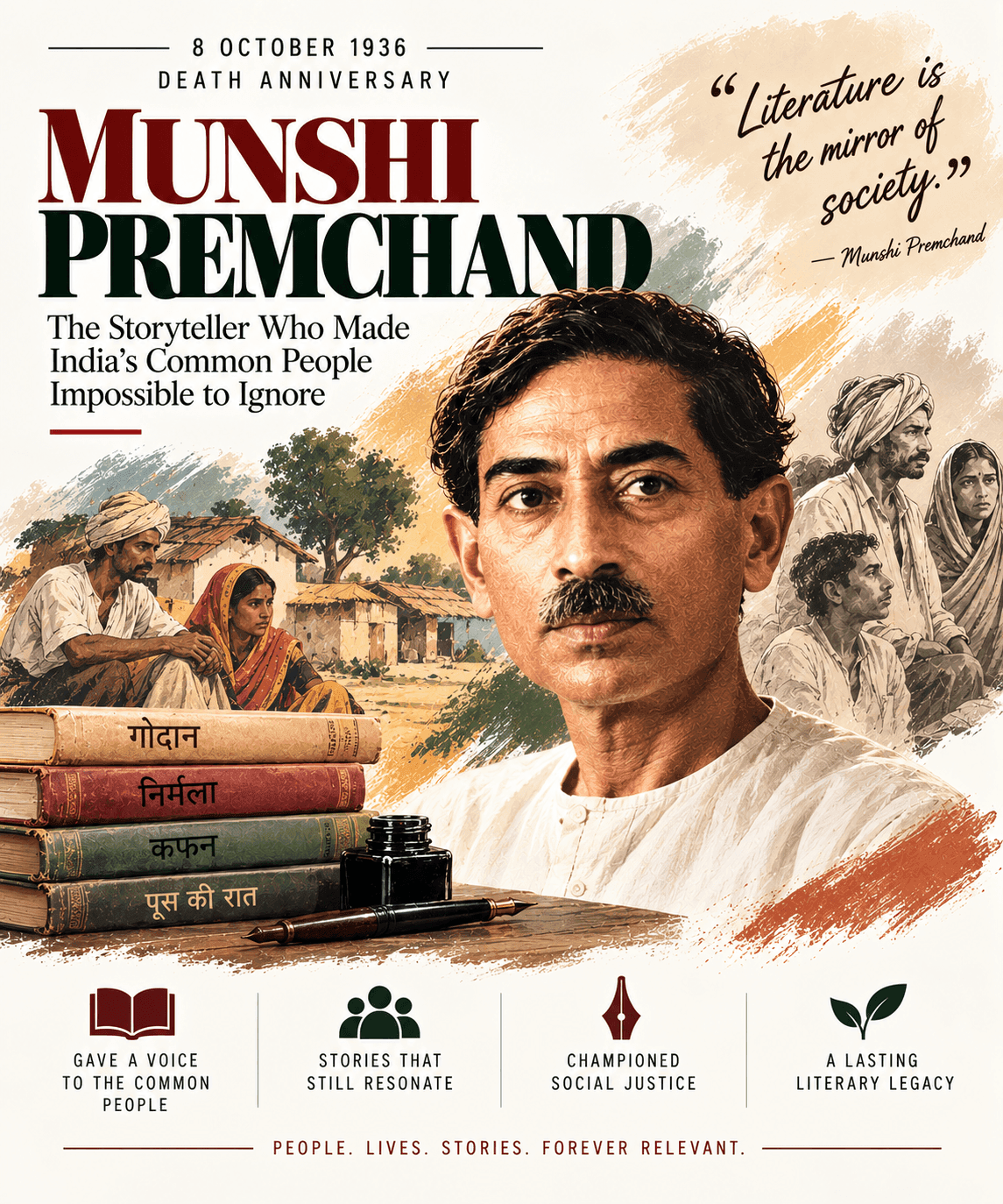
Munshi Premchand: The Storyteller Who Made India’s Common People Impossible to Ignore
In the villages and towns of colonial North India, everyday life was shaped by debt, rigid social customs, limited education and unequal power. It was this world, rather than the courts of kings or the lives of the privileged, that Munshi Premchand brought into Indian literature with unusual clarity and compassion.
Born Dhanpat Rai Srivastava in Lamhi, near Varanasi, in 1880, he grew up in a modest family. His father, Ajaib Lal, worked as a postal clerk. Premchand experienced personal hardship early in life, including the loss of his mother when he was young. These circumstances helped shape his understanding of deprivation, responsibility and the quiet struggles faced by ordinary families.
Premchand began writing in Urdu under the pen name Nawab Rai. His early work attracted official attention, and a collection of nationalist stories was reportedly seized by the colonial authorities. He later adopted the name Premchand, under which he became widely known. His ability to work across Urdu and Hindi allowed him to connect with a broad reading public during a period when Indian languages were developing new forms of modern prose.
His fiction was distinguished by its social realism. Instead of presenting poverty as a distant subject, he showed how it affected decisions, relationships and self-respect. Farmers struggling with rent and debt, women confined by social expectations, children facing neglect and families divided by economic pressure appear throughout his work. His stories do not simply ask readers to feel sympathy; they encourage them to examine the systems that produce suffering.
Among his best-known novels are Godaan, Gaban, Nirmala, Sevasadan and Karmabhoomi. Godaan, published in 1936, is especially remembered for its portrayal of rural hardship and the burden carried by the peasant Hori. His short stories, including Kafan, Poos Ki Raat, Bade Ghar Ki Beti and Panch Parmeshwar, demonstrate his gift for combining simple language with moral and emotional complexity.
Premchand also worked as a teacher, editor and journalist. He edited the literary magazine Hans and remained engaged with the cultural and political questions of his time. His writing reflected an interest in social reform and national consciousness, yet it avoided reducing characters to slogans. Even when his subjects were severe, he gave them individuality, contradiction and human dignity.
His personal life included his marriage to Shivrani Devi, who later wrote about their shared life and his literary journey. Premchand died on October 8, 1936, leaving behind an influential body of Hindi-Urdu fiction. His passing came soon after the publication of Godaan, a work now regarded as a landmark of Indian literature.
Throughout history, the most enduring writers have often been those who help readers recognise their own society. Premchand deserves to be remembered because he made the lives of India’s common people central to serious literature. In families where his stories are read aloud or discussed in classrooms, his legacy remains a living part of India’s cultural heritage and a testament to the power of humane storytelling.