M. F. Husain: The Painter Who Took Indian Modern Art to the World
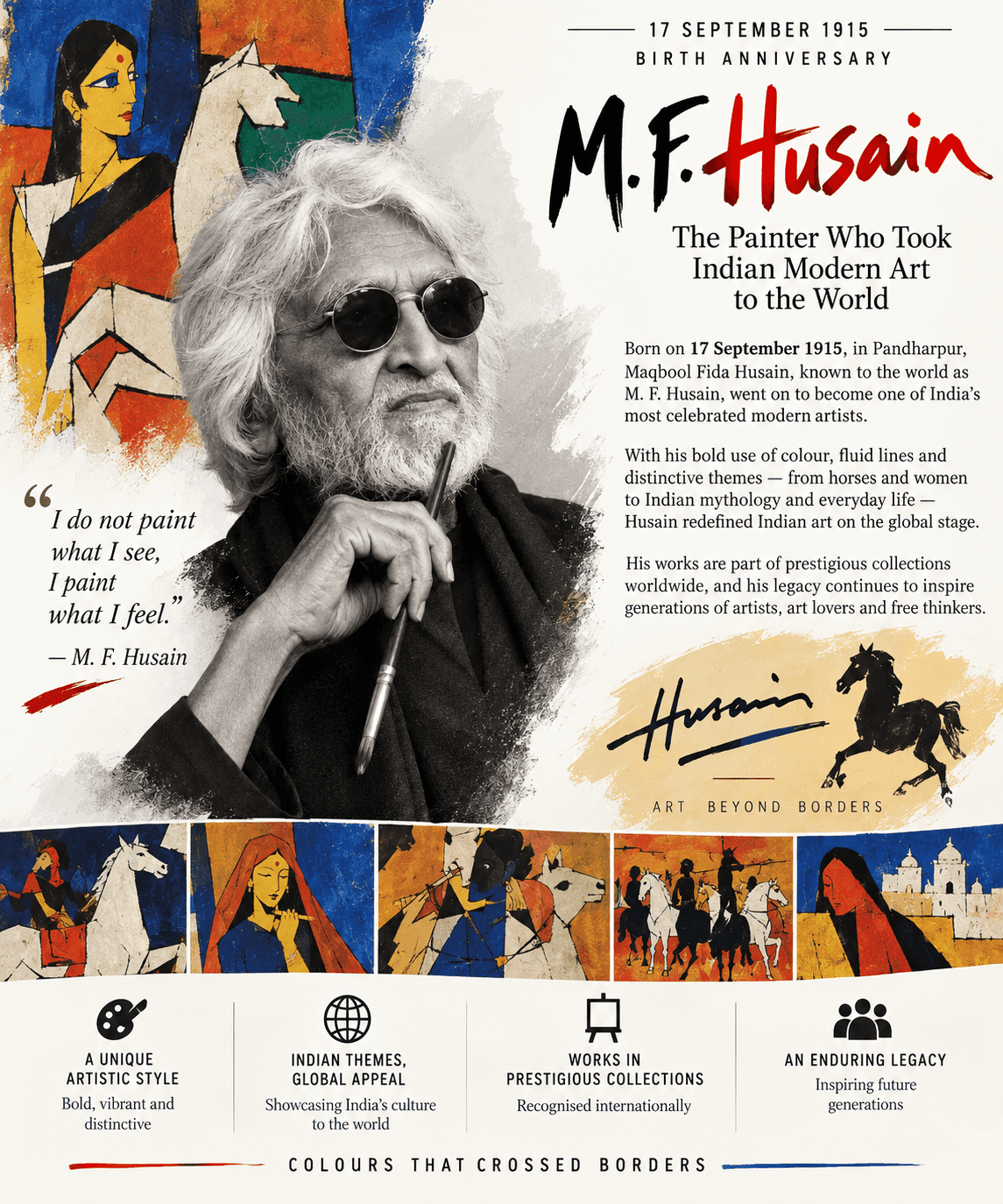
In the crowded cultural landscape of twentieth-century India, M. F. Husain stood out for the unmistakable energy of his paintings. His canvases were filled with sweeping lines, powerful figures and intense colours, often drawing on Indian epics, folk traditions, history and the visual world of cinema. He did not treat heritage as something frozen in the past; he reshaped it into a modern artistic language.
Maqbool Fida Husain was born on September 17, 1917, in Pandharpur, in the Bombay Presidency, now in Maharashtra. His early years were marked by personal loss and financial limitations, but he developed a strong interest in drawing and visual expression. He later spent time in Indore, where his artistic abilities began to take clearer form. As a young man, he moved to Bombay, a city then becoming an important centre of Indian film, advertising and modern culture.
Before gaining recognition as a painter, Husain supported himself in practical ways. He designed and painted large cinema hoardings, an experience that sharpened his command of scale, colour and dramatic composition. The bold visual impact of film posters would remain an important influence on his later work. His art also absorbed the rhythms of Indian streets, village life, religious imagery and the human figure.
The years after independence brought a new confidence to Indian artists. In 1947, Husain became associated with the Progressive Artists’ Group, founded in Bombay by artists who wanted to move beyond restrictive academic traditions and create a modern art rooted in Indian experience. This association helped place him within a wider movement that connected international artistic ideas with the country’s own cultural memory.
Husain’s paintings frequently featured horses, women, mothers, musicians and figures from Hindu mythology. He approached these subjects with an individual visual vocabulary rather than attempting photographic realism. His work was celebrated for its vitality, but some paintings also provoked controversy, particularly when viewers disagreed over his interpretations of religious themes. The debates surrounding his art reflected the difficult relationship between artistic freedom, faith and public identity in modern India.
Painting was not his only form of expression. Husain directed films that revealed his interest in movement, silence and visual narrative. His film Through the Eyes of a Painter received the National Film Award for Best Experimental Film and won the Golden Bear for Best Short Film at the Berlin International Film Festival in 1967. This achievement demonstrated that his creative imagination extended naturally from the canvas to the screen.
Over the course of his career, Husain received some of India’s highest civilian honours, including the Padma Shri, Padma Bhushan and Padma Vibhushan. His work was exhibited in India and abroad, making him one of the country’s most recognisable cultural figures. Later controversies and legal pressures led him to spend much of his final years outside India, and he became a citizen of Qatar in 2010.
M. F. Husain died in London on June 9, 2011. Yet his influence continues through museums, art schools, books and family conversations about Indian culture. He deserves to be remembered not only for individual paintings, but for proving that Indian artistic traditions could speak confidently in a modern, international language. His life remains a testament to the creative possibilities found where heritage, experimentation and personal courage meet.