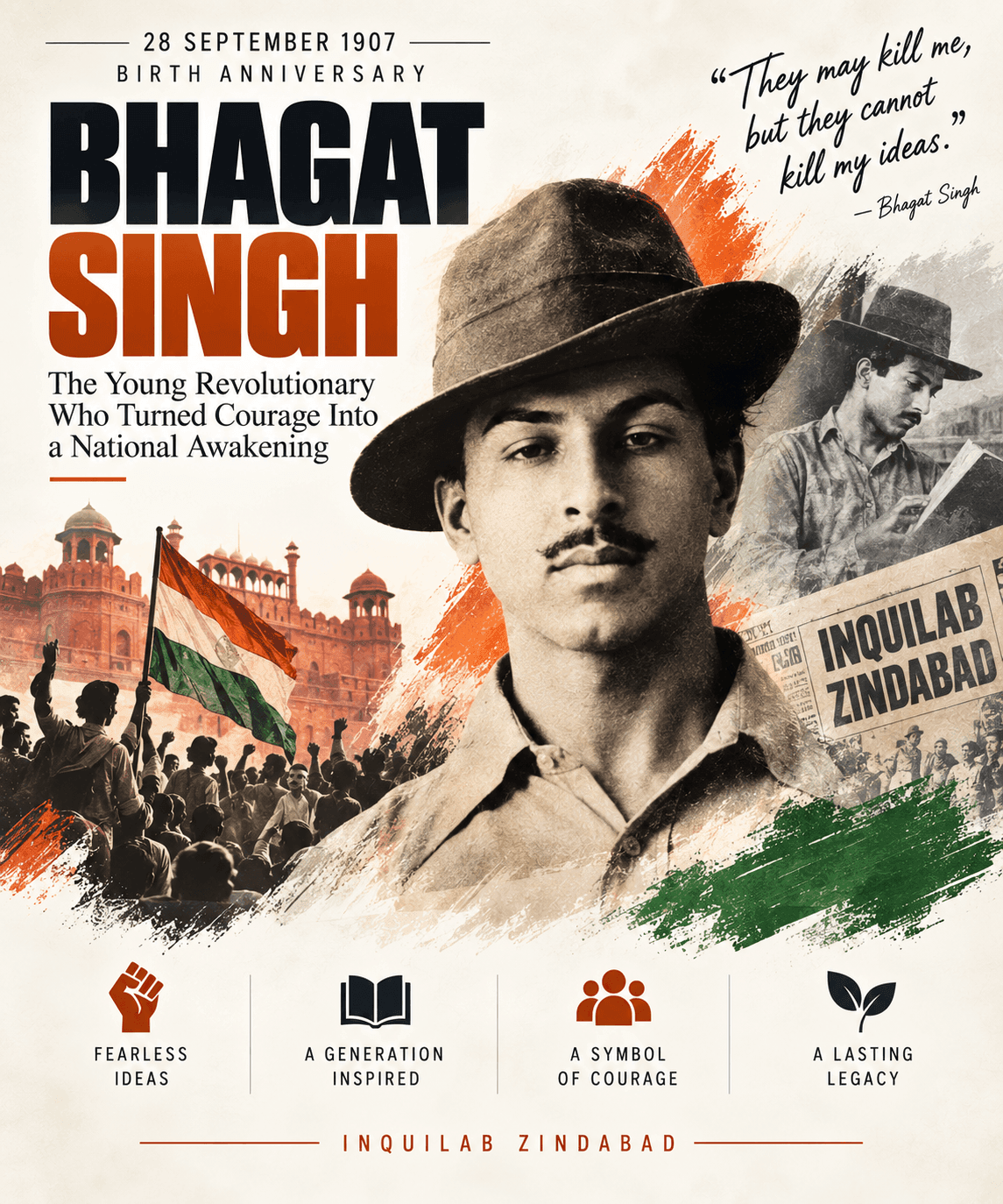
Bhagat Singh: The Young Revolutionary Who Turned Courage Into a National Awakening
In the 1920s, India was filled with political tension. British rule had tightened its grip, public anger was growing and young Indians were debating whether constitutional methods alone could win freedom. It was in this atmosphere that Bhagat Singh emerged as one of the most memorable faces of India’s revolutionary movement.
Bhagat Singh was born on September 28, 1907, in Banga, in the Lyallpur district of Punjab, then part of British India and now in Pakistan. His father, Kishan Singh, and several members of his extended family were associated with nationalist activities. This environment introduced him early to the idea that freedom was not merely a political demand but a responsibility shared by every generation.
The events of his childhood left a lasting impression. The Jallianwala Bagh massacre of 1919 deeply affected public opinion across Punjab, and the young Bhagat Singh became increasingly interested in the history of colonial rule and resistance. He read widely, studied political ideas and looked beyond personal glory. His understanding of revolution gradually developed into a broader belief in social justice, equality and the need to awaken ordinary citizens.
As a young man, Bhagat Singh became associated with revolutionary organisations and helped establish the Naujawan Bharat Sabha in Lahore. The organisation sought to bring young people together, encourage national consciousness and challenge communal divisions. He later worked with the Hindustan Socialist Republican Association, which included revolutionaries such as Chandrashekhar Azad, Rajguru and Sukhdev.
A turning point came after the death of Lala Lajpat Rai, who had been injured during a protest against the Simon Commission. Bhagat Singh and his associates held British officials responsible for the police action. In 1928, an attempt was made to kill the police officer believed to be responsible, but the wrong officer, J. P. Saunders, was shot. The incident forced Bhagat Singh to go underground and intensified the search for him.
On April 8, 1929, Bhagat Singh and Batukeshwar Dutt threw bombs in the Central Legislative Assembly in Delhi. The devices were deliberately intended to cause limited harm, while the accompanying leaflets and slogans protested repressive colonial laws. They did not flee. Their surrender gave them a public platform from which they used the court proceedings and a hunger strike to draw attention to the treatment of political prisoners.
Bhagat Singh’s writings and statements revealed a thoughtful revolutionary who questioned injustice and rejected communal hatred. His trial attracted widespread attention, and his courage turned him into a national symbol. He was executed in Lahore Jail on March 23, 1931, along with Rajguru and Sukhdev.
Throughout history, few young figures have left such a strong impression in so short a life. Bhagat Singh is remembered not only for bravery but also for his intellectual curiosity, secular outlook and commitment to a just society. His story remains part of India’s living heritage, passed through classrooms, family conversations and public commemorations. In today’s world, his legacy serves as a reminder that courage becomes truly meaningful when it is joined with responsibility, thought and concern for the future of the nation.