Asha Bhosle: The Voice That Gave Indian Cinema Its Boldest Musical Colours
In the crowded and creative world of Indian cinema, a playback singer had to do more than sing accurately. The voice had to express a character’s age, mood, energy and inner world, often without appearing on screen. Asha Bhosle mastered that demanding art and helped transform the sound of Hindi film music over several decades.
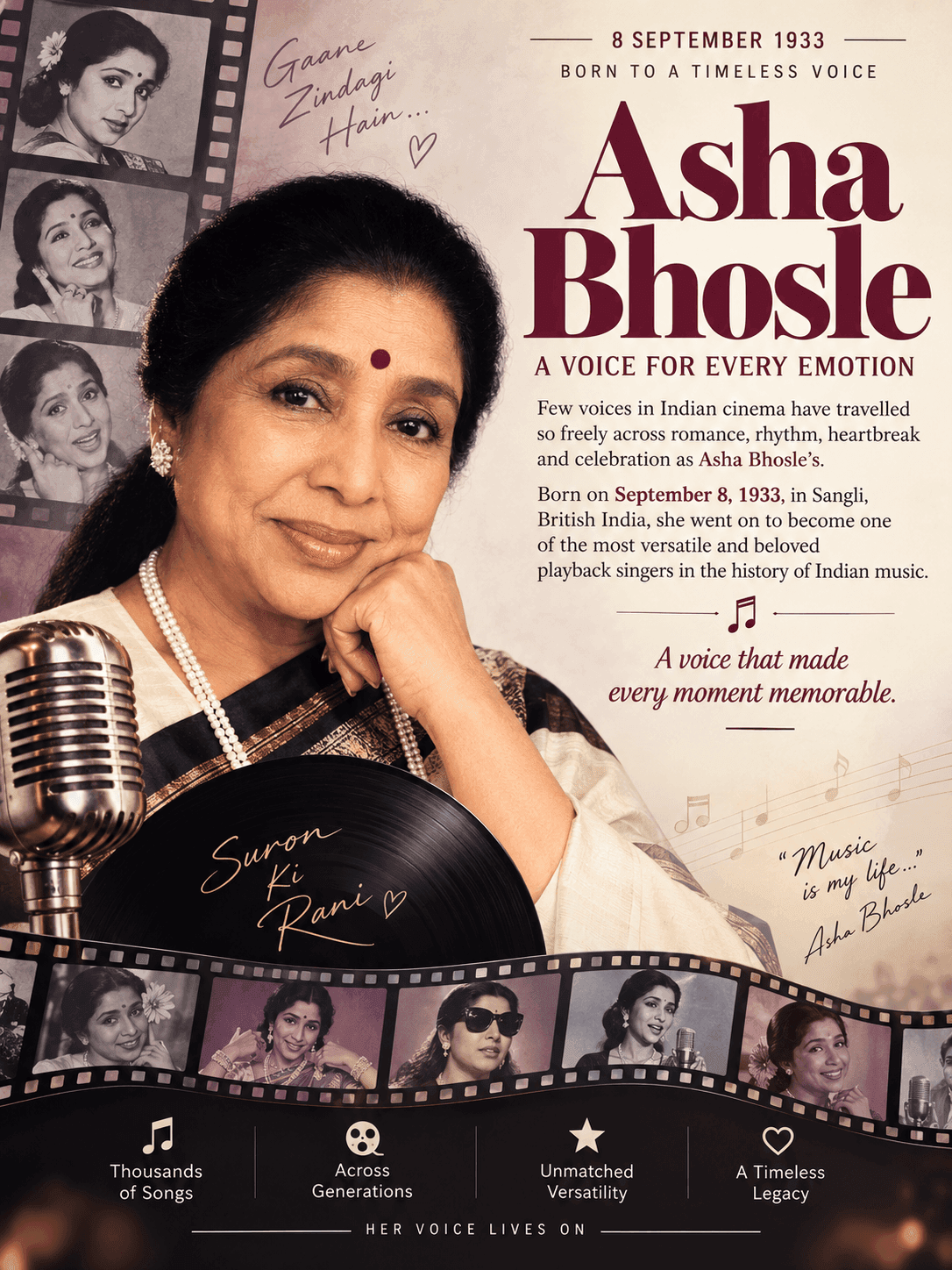
Born on September 8, 1933, in Sangli, British India, Asha Bhosle grew up in a family deeply connected with music and theatre. Her father, Dinanath Mangeshkar, was a respected classical singer and stage performer. The musical environment at home shaped Asha and her siblings, including Lata Mangeshkar, Usha Mangeshkar, Meena Mangeshkar and Hridaynath Mangeshkar. After her father’s death, the family faced difficult circumstances, and the young Asha began working as a singer to support the household.
Her early career developed in Marathi and Hindi cinema at a time when established singers already dominated the industry. She began recording while still very young, taking on opportunities that were not always available to leading playback voices. This period demanded persistence. Instead of remaining confined to one style, Bhosle accepted a wide variety of songs and gradually built a reputation for flexibility, clarity and expressive power.
The 1950s brought a significant change in her professional standing. Her work with composer O. P. Nayyar, including songs associated with films such as Naya Daur, displayed a fresh, rhythmic energy. Bhosle’s voice could sound playful, sensuous, mischievous, intimate or deeply emotional. This range allowed her to become a compelling choice for songs that required a distinct personality rather than a merely polished performance.
Her artistic journey expanded further through collaborations with composers such as Ravi, Khayyam, R. D. Burman and others. She sang in many Indian languages and moved comfortably between film songs, ghazals, classical-based compositions, devotional music and popular numbers. Her partnership with R. D. Burman became especially important, producing memorable work that reflected the changing musical tastes of the 1960s, 1970s and 1980s. Their professional association later became a personal one when they married.
Bhosle’s career was also notable for her ability to remain relevant as cinema and recording technology changed. She lent her voice to generations of actresses and adapted to new arrangements without losing her distinctive identity. Her acclaimed work included songs from films such as Umrao Jaan and Ijaazat, demonstrating that her artistry extended well beyond high-energy numbers. She received National Film Awards and numerous other honours, including the Padma Vibhushan, one of India’s highest civilian awards.
It is important to note that Bhosle’s influence cannot be measured only by awards or hit songs. She helped establish playback singing as an art of interpretation, where phrasing, pronunciation and emotional timing could shape a film character as powerfully as acting. Her recordings travelled across languages, regions and generations, becoming part of weddings, celebrations, radio memories and family playlists.
In conclusion, Asha Bhosle deserves to be remembered as more than a prolific playback singer. She was an adaptable artist who turned challenge into opportunity and variety into strength. Her voice remains woven into India’s cultural tapestry, offering families and history lovers a living reminder of how cinema, music and heritage can travel together across generations.