A. P. J. Abdul Kalam: From Rameswaram Shores to India’s Missile Man
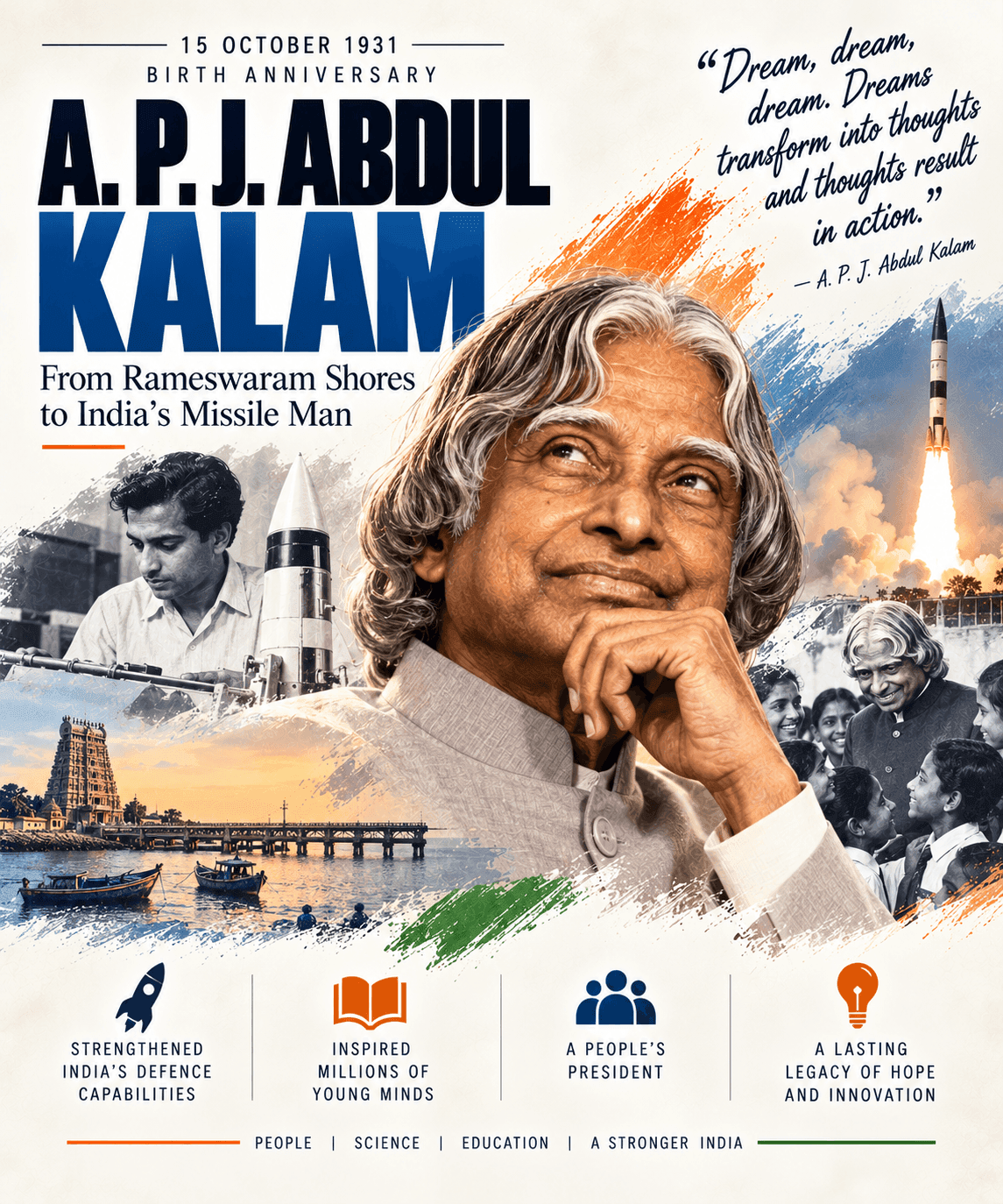
In the island town of Rameswaram, where pilgrimage, the sea and everyday life met, a child was born who would eventually help India reach for the skies. Avul Pakir Jainulabdeen Abdul Kalam was born on October 15, 1931, in Rameswaram, Madras Presidency, British India. His early surroundings were simple, but his ambitions gradually grew far beyond the town’s shores.
Kalam came from a close-knit Tamil Muslim family. His father, Jainulabdeen, was associated with the local community and ferry services, while his mother, Ashiamma, was known for her care and generosity. The values of discipline, simplicity, faith and compassion that he encountered at home remained visible throughout his public life. As a schoolboy, Kalam developed a strong interest in mathematics and science. His early education helped him understand that learning could open doors even when material resources were limited.
After completing his studies, Kalam pursued aeronautical engineering at the Madras Institute of Technology. This training gave direction to his fascination with flight and aircraft. He later joined India’s Defence Research and Development Organisation, beginning a professional journey in which science was closely linked to national self-reliance.
Kalam’s career became especially significant through his work with India’s space and defence programmes. At the Indian Space Research Organisation, he served as project director for the Satellite Launch Vehicle-3 programme. The successful launch of Rohini satellite RS-1 in 1980 marked an important step in India’s developing space capability. His work on launch vehicles and later missile development earned him the popular title “Missile Man of India.”
He also played an important role in the Integrated Guided Missile Development Programme and contributed to major national technology initiatives. Kalam’s achievements were not limited to laboratories. He became known for explaining science in an accessible way and for encouraging young people to think boldly about India’s future. His books, including Wings of Fire, helped readers understand both the challenges of scientific work and the discipline behind achievement.
In 2002, Kalam became the eleventh President of India. His term lasted until 2007, and his approachable manner made the office feel especially connected to students and ordinary citizens. Instead of presenting science and public service as distant subjects, he spoke about them as responsibilities that every young Indian could share. His vision emphasised education, innovation and the transformation of India into a developed nation.
It is important to note that Kalam’s public appeal rested not only on his professional accomplishments but also on his personal simplicity. He remained deeply interested in students, teachers and the role of knowledge in building a better society. He received several honours, including the Bharat Ratna, India’s highest civilian award.
A. P. J. Abdul Kalam deserves to be remembered as a scientist who helped strengthen India’s technological confidence and as a president who made learning feel like a national mission. His journey from Rameswaram to Rashtrapati Bhavan remains part of India’s modern heritage. For families, his story serves as a reminder that curiosity, perseverance and education can carry an ordinary beginning towards an extraordinary legacy.
Click here to learn more about A. P. J. Abdul Kalam’s Family Tree