
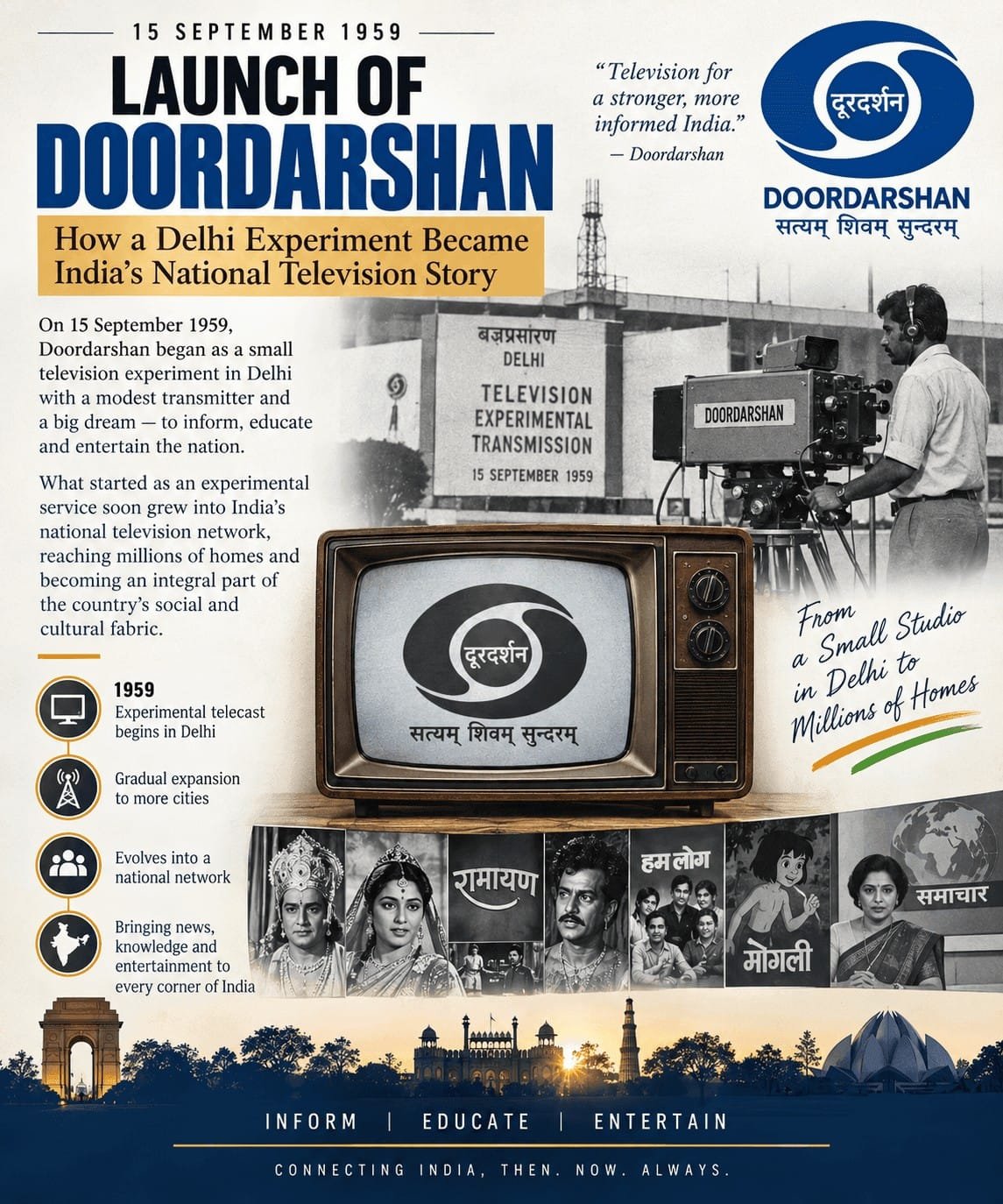
Launch of Doordarshan: How a Delhi Experiment Became India’s National Television Story
In the late 1950s, television was still unfamiliar to most Indians. Radio had already become an important medium for news, education and entertainment, but moving images on a screen represented a different kind of possibility. It was in this atmosphere of experimentation and nation-building that India began its television journey.
On September 15, 1959, experimental television transmission began from Delhi under the name Doordarshan. The launch was not a large commercial spectacle. It was the beginning of a public broadcasting experiment, designed to understand how television could serve a developing country. Its importance lay not in the size of the first audience, but in the idea that a new medium could connect people with knowledge, culture and national life.
The early service had a limited geographical reach and modest resources. Television sets were not common household possessions, and broadcasts were still being tested. Yet the experiment created a foundation for future growth. Doordarshan’s role was closely connected to the wider objectives of public broadcasting: bringing useful information to citizens, supporting education and reflecting India’s many languages, traditions and cultural practices.
As the service developed, television gradually moved beyond the confines of an experiment. Broadcasts became more regular, and programming expanded to include news, educational content, agriculture-related information, cultural presentations and entertainment. For many families, the television set became a shared window to events and experiences that had previously felt distant. It brought national ceremonies, sporting occasions, music, drama and public information into living rooms across the country.
Doordarshan’s growth also mirrored India’s changing communication landscape. The service remained closely associated with the public responsibilities of broadcasting at a time when television was not yet dominated by private channels. Its programmes helped familiarise viewers with different regions and cultural forms, contributing to a broader sense of national connection. In an immensely diverse country, that role gave the medium a significance beyond entertainment.
Important milestones followed. Regular television broadcasting expanded in the 1960s, while colour television arrived in India in 1982. The same period saw the wider national visibility of Doordarshan through major events, national programming and popular serials. For a generation, its signature opening, news bulletins and scheduled programmes became part of the rhythm of everyday life. Grandparents, parents and children often gathered around one screen, turning television viewing into a shared family experience.
It is important to note that the launch of Doordarshan was not simply the introduction of a technology. It was also an institutional commitment to using broadcasting for public service in a newly independent nation. The service offered a platform through which India could communicate with itself, preserve cultural expression and present national developments to a broad audience.
In today’s world of smartphones, streaming platforms and endless channels, the first Doordarshan transmission may seem simple. Its historical importance, however, remains unmistakable. The Delhi experiment of September 15, 1959, began a broadcasting journey that shaped how millions of Indians learned, watched and remembered public life. Doordarshan deserves to be remembered as a foundational part of India’s modern heritage, familiar to families whose memories are tied to the glow of a shared television screen.