
Chandrayaan-2: The Landing Attempt That Took India Closer to the Moon’s South Pole
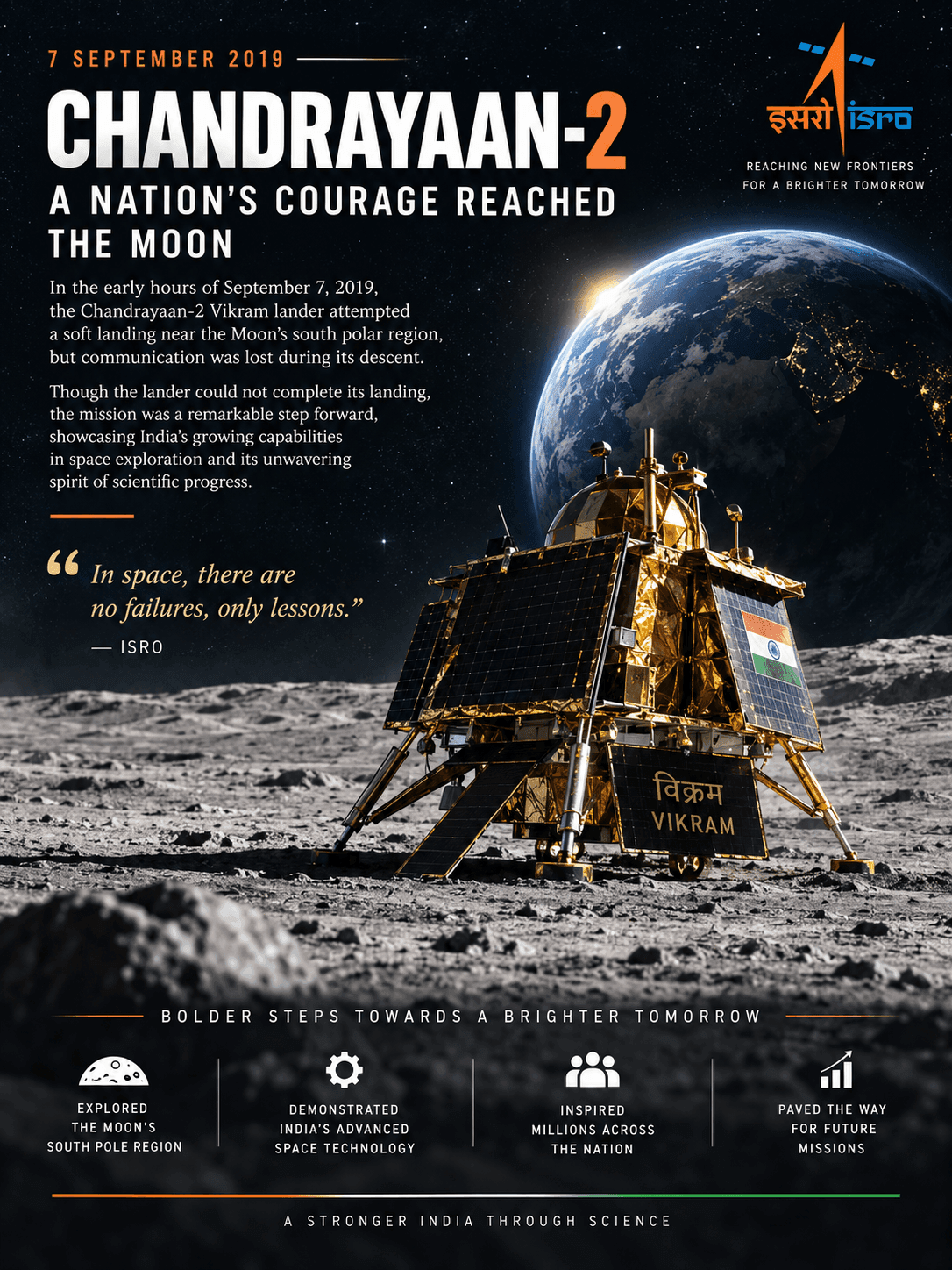
The night of September 7, 2019, brought India to the edge of a historic lunar achievement. In the early hours, the Vikram lander of Chandrayaan-2 began its final descent towards the Moon’s south polar region. The mission was designed to perform a controlled soft landing, something India had not attempted before. As the lander approached the surface, communication was lost. The event became one of the most closely followed moments in the history of India’s space programme.
Chandrayaan-2 grew from India’s desire to study the Moon in greater detail. The mission was developed by the Indian Space Research Organisation, or ISRO, as a more advanced successor to Chandrayaan-1. While Chandrayaan-1 had helped establish India’s role in lunar exploration, Chandrayaan-2 aimed to combine orbital observation with a landing and surface exploration. Its destination was especially significant: the Moon’s south polar region, an area considered scientifically valuable and technically challenging because of its rugged terrain, deep shadows and difficult lighting conditions.
The spacecraft began its journey on July 22, 2019, when it was launched from India. Chandrayaan-2 consisted of three principal parts: an orbiter, the Vikram lander and the Pragyan rover. The orbiter was intended to study the Moon from above for an extended period. Vikram was designed to descend to the surface, while Pragyan was meant to travel across the lunar ground and examine its surroundings. Together, they represented a major step beyond simply observing the Moon from orbit.
The spacecraft spent weeks travelling through space and carefully adjusting its path before entering lunar orbit. The orbiter separated from the lander, and Vikram began preparing for the most demanding stage of the mission. Landing on the Moon requires precise navigation, controlled braking and the ability to respond to changing conditions in a matter of seconds. The south polar landscape made the task even more difficult, as uneven ground and permanently shadowed areas complicated the search for a suitable landing zone.
During the landing attempt, Vikram followed its descent sequence, but communication was lost when it was close to the lunar surface. The planned deployment of Pragyan could not take place as intended. For many Indians, the moment was difficult, yet it did not erase the mission’s achievements. The Chandrayaan-2 orbiter continued functioning and supplied valuable observations of the Moon. Its instruments expanded scientific knowledge and helped demonstrate the importance of maintaining a capable spacecraft in orbit, even when a landing attempt does not proceed as planned.
It is important to note that space exploration advances through both achievements and setbacks. The Vikram landing attempt offered ISRO practical experience in autonomous descent, navigation, communication and lunar mission management. That experience became part of India’s continuing journey towards future exploration. In today’s world, Chandrayaan-2 also shows how scientific missions inspire families, students and young researchers to look beyond familiar horizons.
In conclusion, the Chandrayaan-2 Vikram lander landing attempt deserves to be remembered not simply as a communication loss, but as a courageous chapter in India’s lunar story. It carried the nation’s ambitions to a challenging region of the Moon and strengthened the foundations for later missions. Throughout history, progress has often emerged from difficult attempts. This remarkable story remains a testament to Indian scientific perseverance and a beacon of hope for the generations who will continue to explore the skies.