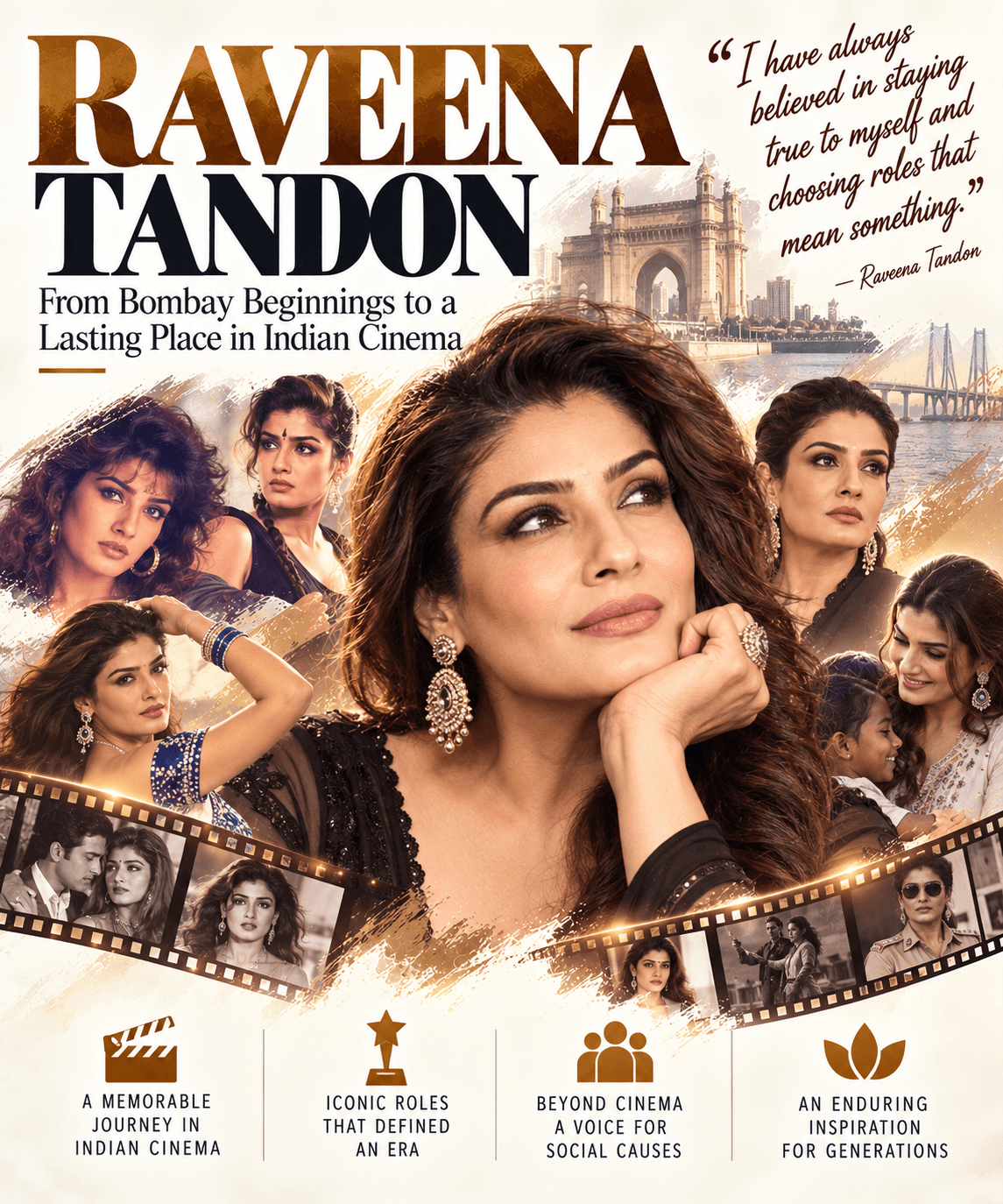
Raveena Tandon: From Bombay Beginnings to a Lasting Place in Indian Cinema
In the lively film culture of Bombay, Raveena Tandon grew up close to the world of cinema. Born on October 26, 1974, she is the daughter of filmmaker Ravi Tandon and Veena Tandon. Her family connection to the industry offered an introduction to filmmaking, but it did not define the entire course of her career. Tandon entered Hindi cinema at a time when the industry was changing rapidly, with younger actors, new musical styles and a growing appetite for different kinds of screen personalities.
Her acting debut came with Patthar Ke Phool in 1991, opposite Salman Khan. The film brought her early recognition and earned her the Filmfare Award for New Face of the Year. Rather than being limited to one screen image, she soon explored a variety of genres. Films such as Mohra, Dilwale, Laadla and Khiladiyon Ka Khiladi established her as a popular leading actor, while comedy entertainers including Andaz Apna Apna and Dulhe Raja highlighted her timing and lively screen presence.
The 1990s were an important period for Hindi cinema, and Tandon became part of the era’s most recognisable cultural memories. Songs, fashion and family-friendly entertainers helped films reach audiences far beyond the theatre. Her performances in commercial cinema made her widely known, but her later choices showed an interest in roles with greater emotional and social depth.
A significant turning point came with Daman: A Victim of Marital Violence. In the film, Tandon portrayed a woman facing domestic abuse and the difficult consequences of an oppressive marriage. The role demanded restraint and emotional intensity rather than the glamour associated with many of her earlier appearances. Her performance won the National Film Award for Best Actress, affirming her ability to handle serious subjects and challenging characters.
Tandon’s work has extended beyond acting. She has appeared in television programmes, participated in judging and hosting projects, and taken on responsibilities as a film producer. These experiences reflect the changing nature of the Indian entertainment industry, where performers increasingly move between cinema, television and other creative platforms.
It is important to note that her career has lasted through several distinct phases of Hindi cinema. She began during the age of video cassettes and single-screen popularity, continued through the expansion of satellite television, and remained visible as digital platforms transformed how audiences discover films and performers. Her ability to remain relevant across these changes is one of the defining features of her professional journey.
Tandon has also been associated with charitable and social initiatives, including causes involving children and animal welfare. Her public life therefore combines entertainment with a wider sense of responsibility. In today’s world, her career serves as a reminder that stardom can evolve when talent is supported by reinvention.
In conclusion, Raveena Tandon deserves to be remembered not only for iconic songs and popular films, but also for the range she brought to Indian cinema. From her Bombay beginnings to award-winning dramatic work, her story forms part of the rich cultural tapestry families have shared across generations. Her birth anniversary invites viewers to revisit a career that continues to connect personal memory with the history of Hindi film.