
The Sompura Family: 15 Generations of Temple Architecture Behind Ram Mandir
The Sompura Family: 15 Generations of Temple Architecture Behind Ram Mandir
A surname can tell you where a family came from.
But sometimes, it can tell you what a family has spent generations learning.
The Sompura family is one such example. For around 15 generations, members of the family have carried forward the traditional knowledge of temple architecture, passing skills from one generation to the next.
Their story stretches from the reconstruction of Somnath to temples across India and abroad and eventually to the Ram Mandir in Ayodhya.
What makes the story remarkable is not simply the buildings they designed.
It is the knowledge that survived long enough to build them.
Who Are the Sompuras?
The Sompura surname is closely associated with a traditional lineage of temple architects and craftsmen from Gujarat, particularly the Palitana region.
Their work draws from traditional Indian architectural knowledge, including principles associated with Vastu Shastra and Shilpa Shastra.
The exact identity of the family’s first temple architect is not known. After roughly 15 generations, even the family has acknowledged that it is difficult to identify which ancestor designed its earliest temple.
That makes the lineage unusual.
The profession became so deeply embedded in the family that the knowledge survived even when individual names did not.
The Sompura Family Tree: A Living Lineage of Knowledge
A complete Sompura family tree covering all 15 generations is not publicly documented in sufficient detail to reconstruct with certainty.
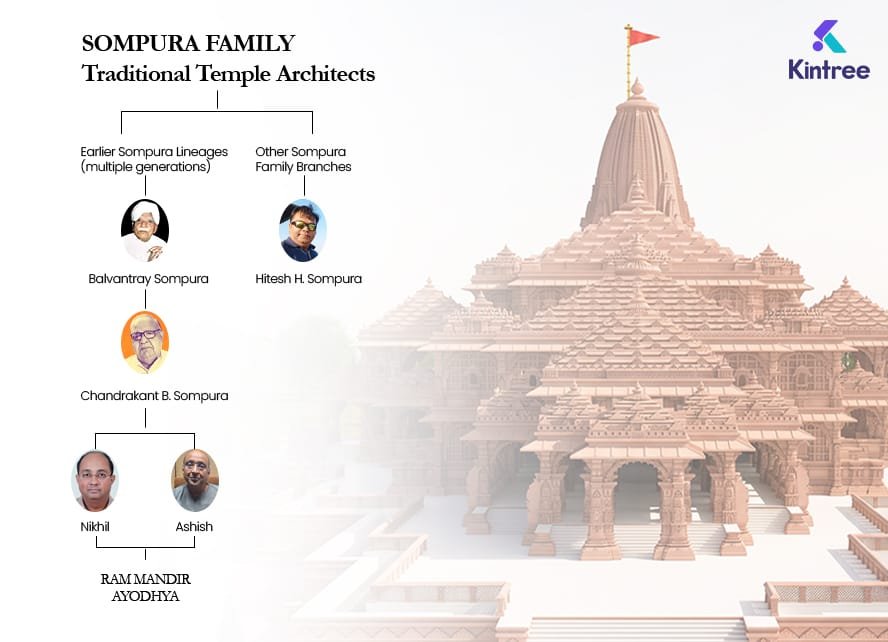
However, the modern lineage gives us an important picture of how the profession was passed forward:
Prabhashankar Oghadbhai Sompura
1896–1978/79
Temple architect associated with the reconstruction of Somnath
↓
Balvantrai Sompura
Son of Prabhashankar
↓
Chandrakant Balvantray Sompura
Born: 8 November 1943
Principal architect associated with Ram Mandir
↓
Nikhil Sompura & Ashish Sompura
Next generation involved in temple architecture and Ram Mandir
This is a documented modern lineage, not a complete 15-generation genealogy.
That distinction matters. A family tree should preserve what is known without filling historical gaps with assumptions.
Prabhashankar Sompura and the Reconstruction of Somnath
One of the most important figures in the modern Sompura family story was Prabhashankar Oghadbhai Sompura.
Born in 1896, he became a prominent scholar and practitioner of traditional temple architecture.
After India’s Independence, he was associated with the reconstruction of the Somnath Temple. His work helped connect an ancient architectural tradition with one of independent India’s most significant temple reconstruction projects.
But perhaps his greatest contribution to the family was more personal.
He became the teacher of his grandson, Chandrakant.
The knowledge moved from one generation to another.
Chandrakant Sompura: From Grandfather’s Workshop to Ram Mandir
Chandrakant Balvantray Sompura was born on 8 November 1943 in Palitana, Gujarat.
After his father’s death in 1967, Chandrakant continued his training under his grandfather Prabhashankar. He spent around 15 years learning through practical experience and studying traditional architectural principles.
He later took charge of the family’s architectural practice and worked on numerous temples in India and overseas.
Among the projects associated with his career are the Somnath Temple, Akshardham in Gandhinagar and temples in countries including the United Kingdom, Singapore and Thailand.
In 2025, Chandrakant Sompura received the Padma Shri for his contribution to architecture.
His career shows how an inherited profession can survive without becoming frozen in the past.
The principles remained traditional.
The projects kept changing.
The Ram Mandir Connection
The Ram Mandir in Ayodhya became the most visible chapter in the family’s modern story.
Chandrakant Sompura first visited the proposed temple site decades before construction began. During one early visit, he reportedly measured the sanctum area using his footsteps because he could not take measuring equipment into the site.
The design that eventually emerged followed the Nagara style of Hindu temple architecture.
His sons, Nikhil Sompura and Ashish Sompura, were also involved in the project.
That makes Ram Mandir more than a major architectural commission for the family.
It became another point in a lineage where one generation’s knowledge was used, adapted, and carried forward by the next.
What Makes Sompura Architecture Distinctive?
Sompura architecture is rooted in traditional Indian temple-building principles rather than treating a temple simply as a large structure.
The Nagara style is characterised by features such as the shikhara, mandapas, carefully proportioned spaces, and an architectural relationship between the structure and its religious purpose.
The Ram Mandir follows this tradition at a monumental scale, with the main temple measuring approximately 380 feet long, 250 feet wide and 161 feet high.
But dimensions only tell part of the story.
The more important inheritance is the knowledge behind those measurements: how proportions are determined, how spaces relate to one another, how traditional forms are interpreted, and how craftsmen translate those principles into stone.
That knowledge cannot be passed down through a blueprint alone.
It has to be taught.
When a Surname Becomes a Repository of Knowledge
This is the deeper story behind the Sompura surname.
The family did not merely pass down a business.
It passed down knowledge.
A grandfather taught a grandson. A father worked alongside his sons. Younger generations entered the same profession. Each generation inherited something from the previous one and then carried it into a different time.
Most families have their own version of this.
Perhaps it is a recipe known only to one grandmother. A craft learned from a grandfather. A business practice that made the family successful. A traditional skill that nobody has written down.
The hidden risk is that families often preserve the outcome but lose the knowledge behind it.
They remember that something was made, achieved, cooked, built or practised.
They forget who taught it and how.
Preserving Family Knowledge with Kintree
This is where a family tree can become more than genealogy.
Kintree allows families to connect people with the stories, photographs, memories and knowledge associated with them.
A Sompura family tree, for example, is not meaningful simply because it shows who belonged to which generation. Its real value lies in showing how knowledge moved between those generations.
The same principle applies to any family.
When an old photograph is connected to the person in it, when a recipe is connected to the person who taught it, or when a family tradition is connected to the generation that started it, the past becomes easier to understand.
The family tree becomes a map of inheritance—not just of people, but of knowledge.
Conclusion
The story of the Sompura family is ultimately bigger than Ram Mandir.
It is the story of what happens when knowledge becomes part of a family’s identity.
For around 15 generations, temple architecture has been carried through the family—not perfectly documented at every stage but continuously practised and taught.
Prabhashankar passed knowledge to Chandrakant.
Chandrakant carried it into a new era.
The next generation is carrying it forward again.
That is what makes a surname powerful.
It can become more than a name.
It can become a repository of everything a family has learned and chosen not to lose.
This Blog is generated using information collected from various sources. Some details may be inaccurate, incomplete, or outdated. Please verify the information before relying on it.
Share This Story, Choose Your Platform!
Related Blogs
The 1875 Family Tree That Became Evidence in Court
In 1875, Shah Nawaz Din sat down and recorded his ....
APJ Abdul Kalam Family Tree: The Humble Roots Behind a Remarkable Legacy
Every year on October 15, India remembers Dr. A.P.....
Nana Patekar Beyond Cinema: His Family Tree, Roots and Relationships
Veteran actor Nana Patekar's passing on October 8,....
Sheikh Ahmed bin Rashid Al Maktoum: A Life Within the Al Maktoum Family Tree
When Sheikh Mohammed bin Rashid Al Maktoum became ....