
The Pandya Dynasty: Kings, Family Tree and the Story of a Tamil Empire
The Pandya Dynasty: Kings, Family Tree and the Story of a Tamil Empire
What makes a dynasty worth remembering?What makes a dynasty worth rememberin?
What makes a dynasty worth remembering?
Not only the land it controlled, but the people who built it, the relationships that shaped succession and the stories that survived after its rulers were gone.
The Pandya dynasty offers all three.
From ancient Tamilakam to the height of the Pandya Empire, the Pandyas influenced southern Indian politics, maritime trade, religion and Tamil culture. Their history is also a story of a royal family whose branches expanded, competed and survived across generations.
Where Did the Pandya Dynasty Begin?
The Pandyas were one of the three major Tamil kingdoms of ancient South India, alongside the Cholas and Cheras.
Madurai became their best-known political and cultural centre, while Korkai was closely associated with pearl fishing and maritime commerce.
The sea was central to Pandya prosperity. The Gulf of Mannar was famous for its pearl fisheries, while the southern coastline connected the kingdom to wider Indian Ocean trade networks.
So, Pandya power was not built through armies alone. Trade, political alliances, temple patronage and control of important territories all played a role.
The Pandya Family Tree: Major Rulers
Reconstructing the Pandya dynasty family tree is difficult. Several rulers shared names such as Maravarman, Jatavarman and Sundara Pandyan, while records for many early rulers are incomplete.
Exact birth dates are therefore unknown for most of the dynasty. Where evidence is stronger, reign and death dates are more useful.
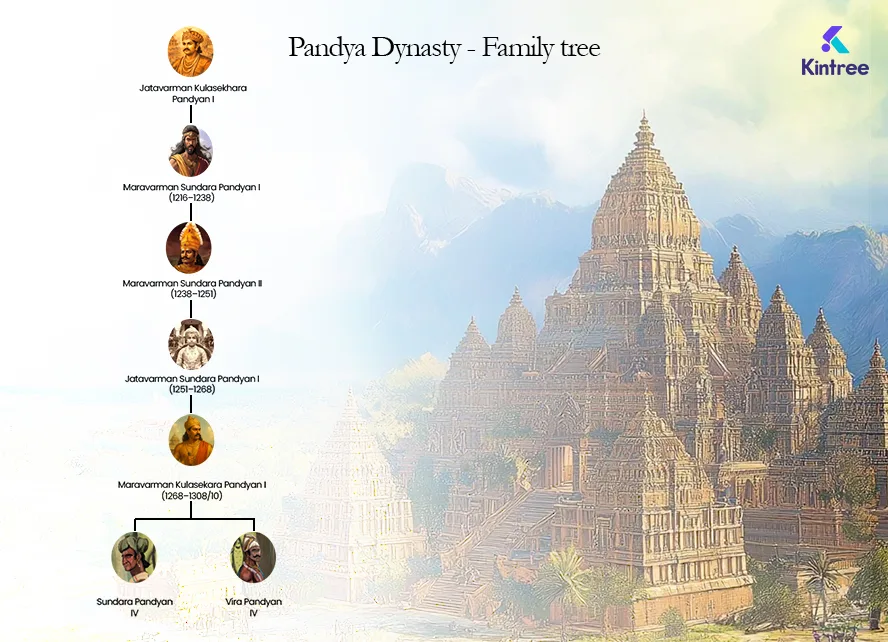
A simplified succession line
Maravarman Sundara Pandyan I
↓
Jatavarman Sundara Pandyan I
↓
Maravarman Kulasekara Pandyan I
↓
Sundara Pandyan & Vira Pandyan
→ competing succession claims
This is a simplified succession line, not a complete genealogical family tree. It highlights the rulers who shaped the dynasty’s powerful medieval phase rather than suggesting that every ruler was a direct parent-child successor.
The Kings Who Built the Pandya Empire
Maravarman Sundara Pandyan I
Reign: 1216–1238 CE
Birth: Unknown
Death: Unknown
He helped restore Pandya political strength after a long period of Chola dominance. His campaigns weakened Chola influence and created conditions for the expansion that followed.
Jatavarman Sundara Pandyan I
Reign: c. 1251–1268 CE
Birth: Unknown
Death: Unknown
Often regarded as one of the greatest Pandya rulers, he dramatically expanded the kingdom’s influence across southern India.
His reign was also marked by major temple patronage. He is associated with substantial donations to important religious centres, including Srirangam.
Maravarman Kulasekara Pandyan I
Reign: 1268–1308 CE
Birth: Unknown
Death: 1308 CE
His long reign represented another powerful phase of the Pandya dynasty.
But his death exposed a problem that many royal families eventually face: succession.
His sons, Sundara Pandyan and Vira Pandyan, became rivals for power.
When the Family Became the Battlefield
The succession dispute following Kulasekara Pandyan I changed the direction of the kingdom.
This is where Pandya dynasty history becomes more than a story of kings and conquests.
The political struggle was also a family struggle. Competing claims weakened central authority and made the kingdom more vulnerable to external pressure.
In 1311, Malik Kafur led a major expedition into the south. The Pandyas did not disappear immediately, however. Different branches continued to exercise authority in parts of southern India after the empire’s peak.
The dynasty survived.
Its political unity did not.
Why the Pandyas Became So Powerful?
Three forces stand out.
The sea: Pearl fisheries and maritime trade brought wealth and international connections.
The sword: Military campaigns allowed powerful rulers to expand Pandya influence.
The temple: Royal patronage supported religious, cultural and economic institutions.
Madurai became an important centre of Tamil culture, while the wider kingdom remained connected to trade across the Indian Ocean.
The Pandya Empire was therefore not simply a military power. It was built through commerce, culture, religion and political authority working together.
What the Pandya Family Tree Teaches Us
Royal genealogies are complicated because families are complicated.
Names repeat. Branches separate. Alliances form. Rivalries emerge. One generation’s decisions alter the lives of the next.
That is exactly what makes a Pandya family tree interesting.
It turns a list of rulers into a story about relationships.
Modern families may have their own forgotten branches: a relative who moved abroad, a marriage that connected two families, an ancestor whose story was never recorded, or an elder who remembers details nobody else knows.
The structure may be different.
The human story is not.
Preserving Your Own Family History with Kintree
The Pandyas left inscriptions, temples, literature and other records that allow historians to reconstruct parts of their past.
Most families are not so fortunate.
Their history may exist only in photographs, old documents, family recipes, conversations or memories held by one elderly relative.
Kintree helps families make those connections visible. A visual family tree can show how branches relate to one another, while photographs, stories and memories can add the context behind each relationship.
That matters because a complicated family history becomes much easier to understand when the relationships are connected rather than remembered as isolated names.
A name tells you who someone was.
A relationship shows where they belonged.
A story tells you why they mattered.
Conclusion
The Pandya dynasty left behind more than kings and conquered territories.
It left a record of generations: rulers who expanded power, families that shaped succession, merchants who crossed seas and communities that carried Tamil traditions forward.
Its complicated succession is a reminder that history is rarely made by individuals alone. Relationships matter too.
The same is true inside our own families.
A name on a family tree tells you where someone fits.
The story behind that name tells you what their place in the family meant.
This Blog is generated using information collected from various sources. Some details may be inaccurate, incomplete, or outdated. Please verify the information before relying on it.
Share This Story, Choose Your Platform!
Related Blogs
APJ Abdul Kalam Family Tree: The Humble Roots Behind a Remarkable Legacy
Every year on October 15, India remembers Dr. A.P.....
Nana Patekar Beyond Cinema: His Family Tree, Roots and Relationships
Veteran actor Nana Patekar's passing on October 8,....

Sheikh Ahmed bin Rashid Al Maktoum: A Life Within the Al Maktoum Family Tree
When Sheikh Mohammed bin Rashid Al Maktoum became ....
Unveiling the Legacy: Lord Rama and the Ikshvaku Dynasty
Lord Rama's place in the Ramayana is closely conne....